Opening Story & Chapter 1
It's still 6:01 AM for you
Mark didn't lose his accounts to elite hackers or a supercomputer. It took one reused password from a forum he joined in 2012. Six months, five thousand dollars in legal fees — and he never got his reputation back.
The 6:02 AM notification
It started with a vibration on the nightstand at 6:02 AM. Before Mark even opened his eyes, he reached for his phone, expecting the usual clutter: a news alert, a weather update, maybe a text from his daughter. Instead, the screen was white. A single system pop-up hovered over his wallpaper:
"Your password was changed 4 minutes ago."
Mark frowned, sleep still clouding his brain. I didn't change my password, he thought. He tapped "Forgot Password." The recovery email on file does not match your records.
Mark sat up. The cold hit him before the panic did.
He tried his email app. Login Failed. He tried his cloud drive, where fifteen years of architectural blueprints, contracts, and client data lived. Access Denied.
Then, later, the text messages started arriving. Not from the system, but from his clients.
"Mark, why are you emailing me for a wire transfer again?"
"Is this a joke? I just got an invoice from you with a new bank account number."
"Mark, please tell me you didn't just upload our entire project folder to a public link on your LinkedIn."
By 7:15 AM, Mark wasn't just locked out of his digital life — he was watching an invisible stranger dismantle his career in real-time.
He dialed his bank, but the automated system asked for a PIN he no longer controlled. He tried to log into his social media to post a warning, but his profile picture had already been replaced, and the bio changed to a crypto-scam link. He sat on the edge of his bed, phone in hand, watching notifications cascade down the screen like rain.
He was a senior partner at a respected firm. He was the guy who "handled everything." And now, he was a ghost in his own life.
It didn't take a team of elite hackers to ruin Mark. It didn't take a supercomputer. It took one reused password from a forum he joined in 2012.
Mark eventually got his accounts back. It took six months, five thousand dollars in legal fees, and endless hours on hold. But he never got his reputation back. The clients who received those fake invoices moved on. The trust was broken. The doubt lingered.
The good news: it's still 6:01 AM for you
Mark's story is over. Yours is happening right now.
You are holding this book because you know, deep down, that you are currently sitting at 6:01 AM. You might have reused a password in 2018. You might have clicked a link that looked 99% real. You are one notification away from the nightmare. But the clock hasn't struck 6:02 yet. You still have the initiative.
The tech industry's answer to this chaos is always the same: "Try Harder." They tell you to memorize complex codes. They blame you for being human. They treat you like an unpaid systems administrator for your own life.
We are done with that. This book is not about doing more. It is about changing the game so you can't lose.
Chapter 1: The unhackable key
The game is rigged. For thirty years, the internet has asked you to do the impossible: memorize dozens of complex codes, never write them down, and never type them into the wrong window. If you fail, you lose your money.
We are going to replace your fragile passwords with passkeys — a system that doesn't rely on secrets you can forget or steal. If a hacker puts a gun to your head and demands your password, you can't give it to them — because with a passkey, you don't even know it. That is true security.
The shift: from knowing to being
A password is something you know. If you know it, you can be tricked into telling it to a scammer, or a server can leak it. A passkey is different — it's stored securely inside your phone. To you, it feels like magic: you look at your phone, it unlocks, you're in. Your technology does the vigilance for you.
Superpower: you cannot be phished
Scammers are masters of disguise. They can build a fake bank website that looks 100% perfect. If you use a password, you will type it in — because you are human. A passkey is not human. It cannot be fooled.
When you try to use a passkey, your phone quietly checks the website's digital ID. If you are on fake-bank.com instead of bank.com, your phone will simply refuse to work. It won't offer up your key. The scammer gets nothing.
You don't have to be vigilant anymore. Your technology does it for you.
The difference between Mark's ruined reputation and a normal Tuesday morning was one decision. You are safe. Your accounts are open. The sun is up. It is 6:01 AM. Let's get to work before the minute hand moves.
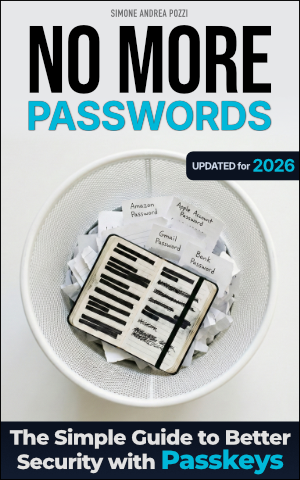
No More Passwords
The full guide walks you through creating your first passkey, securing your email, banking, and social accounts, and setting up a recovery plan that works even if you lose your phone.
From €4.99 · $4.39
Get the full guideAvailable on Amazon Kindle, Apple Books & Google Play